
Understanding GPON Technology in FTTH Networks


Introduction
As Fiber-to-the-Home (FTTH) networks continue expanding worldwide, GPON (Gigabit Passive Optical Network) has become one of the most widely used technologies for delivering high-speed internet. GPON enables Internet Service Providers (ISPs) to provide fast, stable, and scalable broadband connections to homes and businesses using fiber optics.
In this blog, we will understand how GPON works, its components, and why it is important for modern broadband networks.
What is GPON?
GPON (Gigabit Passive Optical Network) is a fiber-optic communication technology used in FTTH networks to deliver high-speed internet, IPTV, and VoIP services.
The word “Passive” means that the network between the ISP and the customer does not require powered equipment. Instead, it uses optical splitters to distribute the signal.
Typical GPON speeds:
Downstream: up to 2.5 Gbps
Upstream: up to 1.25 Gbps
This bandwidth is shared among multiple users connected to the same fiber network.
Main Components of a GPON Network
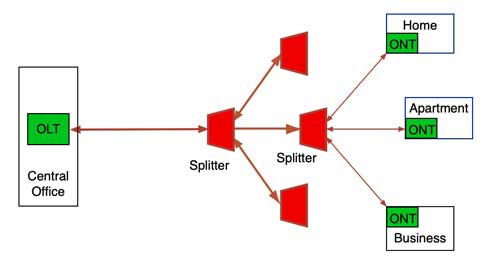
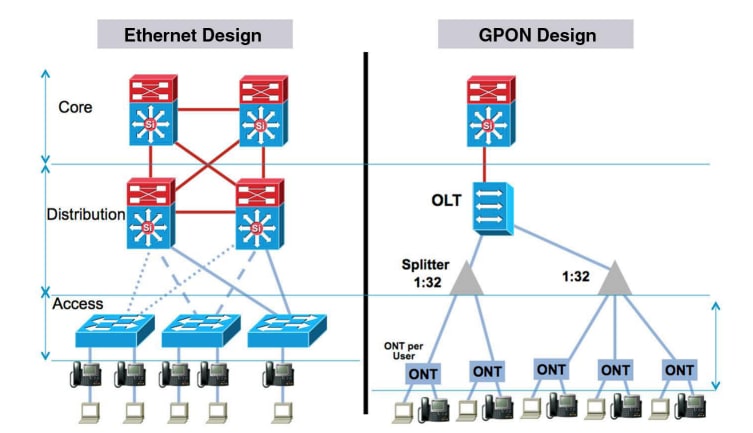
1. OLT (Optical Line Terminal)
The OLT is installed at the ISP's central office.
Functions of OLT:
Sends internet data to customers
Manages bandwidth allocation
Controls connected ONTs
2. Optical Splitter
The splitter divides one fiber signal into multiple fibers.
Example:
1 fiber from OLT → split into 16, 32, or 64 users
Advantages:
No electricity required
Low maintenance
Cost-effective network expansion
3. ONT / ONU (Optical Network Terminal)
The ONT is installed at the customer's home.
Functions:
Converts optical signal → electrical signal
Connects to router, PC, or WiFi device
Provides internet, IPTV, and voice services
Simple GPON Network Flow
Internet
   │
ISP Core Network
   │
OLT (Central Office)
   │
Fiber Cable
   │
Optical Splitter
 ┌────┬────┬────┬────┐
ONT  ONT  ONT  ONT
 │    │    │    │
Users Homes
Advantages of GPON Technology
1. High Speed
Supports gigabit-level broadband suitable for modern applications.
2. Cost Efficient
Passive splitters reduce equipment and power costs.
3. Long Distance
GPON networks can reach up to 20 km without signal regeneration.
4. Scalable
ISPs can add more customers easily using additional splitters.
Common GPON Troubleshooting Tips
Network engineers often face these issues:
1. Low Optical Power
Check fiber connectors
Inspect splice loss
Clean optical ports
2. ONT Not Registering
Verify ONT serial number in OLT
Check fiber connection
Restart ONT device
3. Frequent Disconnection
Check signal level
Inspect fiber bending
Verify splitter port
Conclusion
GPON technology is the backbone of modern FTTH broadband networks. With its high speed, cost efficiency, and scalability, it enables ISPs to deliver reliable internet services to thousands of users through a single fiber infrastructure.
Understanding GPON architecture helps network engineers troubleshoot issues efficiently and maintain stable broadband connections.
✅ Tags:
FTTH, GPON, Fiber Network, Broadband Technology, OLT, ONT, Optical Splitter, ISP Network, Fiber Internet
✅ SEO Keywords:
GPON technology explained, FTTH GPON network, GPON architecture, OLT ONT splitter, fiber broadband technology, GPON troubleshooting guide

0 Response to "Understanding GPON Technology in FTTH Networks"
Post a Comment