
How to Use OTDR in FTTH Network (Complete Practical Field Guide 2026)



Introduction
In FTTH networks, when a major fault occurs — especially fiber cut or high loss — normal troubleshooting is not enough.
That’s where OTDR becomes essential.
If you are a fiber engineer, understanding how to use OTDR properly can save hours of fault finding.
In this guide, you will learn:
What is OTDR?
How OTDR works
How to read OTDR graph
How to find fiber cut distance
Field testing procedure
Common mistakes
What is OTDR?
OTDR stands for Optical Time Domain Reflectometer.
It is a testing instrument used to:
Detect fiber cuts
Measure fiber length
Identify splice loss
Check connector loss
Analyze link quality
It is one of the most important tools in FTTH and backbone networks.
How OTDR Works
FTTH networks use light transmission through fiber under Gigabit Passive Optical Network (GPON) technology.
OTDR works by:
1️⃣ Sending short pulses of light into fiber
2️⃣ Measuring reflected light (backscatter)
3️⃣ Calculating distance based on time
If there is a fault or break, reflection increases.
Distance = (Speed of light in fiber × Time) / 2
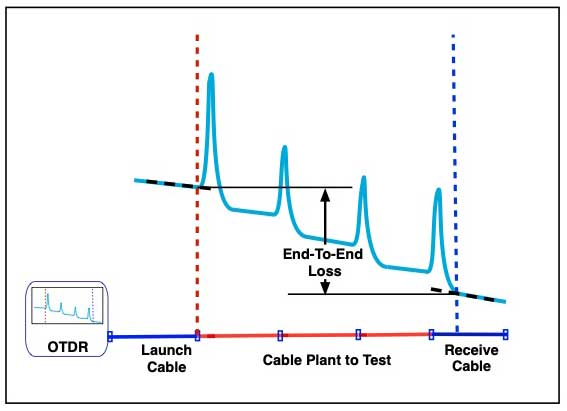
Understanding OTDR Trace Graph
When you test fiber, OTDR shows a graph.
Graph Elements:
X-axis → Distance (in meters or km)
Y-axis → Signal strength (dB)
Key Events on Graph:
✔ Gradual slope → Normal fiber attenuation
✔ Small spike → Splice point
✔ Big spike → Connector
✔ Sharp drop to zero → Fiber cut
How to Detect Fiber Cut Using OTDR
Example:
If OTDR shows sudden drop at 1.8 km:
That means fiber cut is approx 1.8 km from testing point.
You can go directly to that location instead of checking entire route.
This saves huge time in field.
OTDR Testing Procedure (Step-by-Step)
Step 1: Clean Connectors
Always clean fiber connector before testing.
Dirty connector gives wrong reading.
Step 2: Use Launch Cable
Launch cable (100m–500m) helps measure first connector loss correctly.
Without launch cable, first event cannot be analyzed properly.
Step 3: Select Proper Wavelength
Common wavelengths:
1310 nm → Short distance
1550 nm → Long distance
For FTTH, usually 1310 nm is used.
Step 4: Set Pulse Width
Short pulse → Better event resolution
Long pulse → Longer distance measurement
Choose according to link length.
Step 5: Start Test & Save Report
Always save:
Distance
Total loss
Event table
Documentation is important.
Common Field Problems Identified by OTDR
Feeder fiber cut
High splice loss
Water entry in joint
Broken patch cord
Excess bending
Without OTDR, these are difficult to locate.
GPON Limitation in OTDR Testing
Because GPON uses splitters:
Testing through splitter gives multiple reflections.
So best practice:
Test feeder before splitter
Or isolate branch for accurate reading
OTDR vs Optical Power Meter
| Feature | OTDR | Power Meter |
|---|---|---|
| Detects distance | Yes | No |
| Measures splice loss | Yes | No |
| Finds cut location | Yes | No |
| Simple power reading | No | Yes |
Both tools are important in FTTH network.
Common Mistakes Engineers Make
❌ Not using launch cable
❌ Wrong pulse width
❌ Testing through active ONT
❌ Ignoring dead zone
❌ Not saving report
Proper OTDR knowledge makes you a professional fiber engineer.
Practical Example
Complaint: Multiple users down.
OLT shows signal loss.
OTDR result:
Fiber cut at 2.4 km from FDT.
Team goes directly to 2.4 km location →
Road digging damage found →
Splicing done → Service restored.
Without OTDR → whole route checking required.
Conclusion
OTDR is the backbone testing tool for FTTH and backbone fiber networks.
It helps in:
Quick fault detection
Accurate distance measurement
Reducing downtime
Professional troubleshooting
If you want to grow as a senior fiber engineer, mastering OTDR is essential.
SEO Keywords
OTDR full form
How to use OTDR in FTTH
Fiber cut detection using OTDR
OTDR trace analysis
FTTH fiber testing guide
GPON troubleshooting

0 Response to "How to Use OTDR in FTTH Network (Complete Practical Field Guide 2026)"
Post a Comment